Description
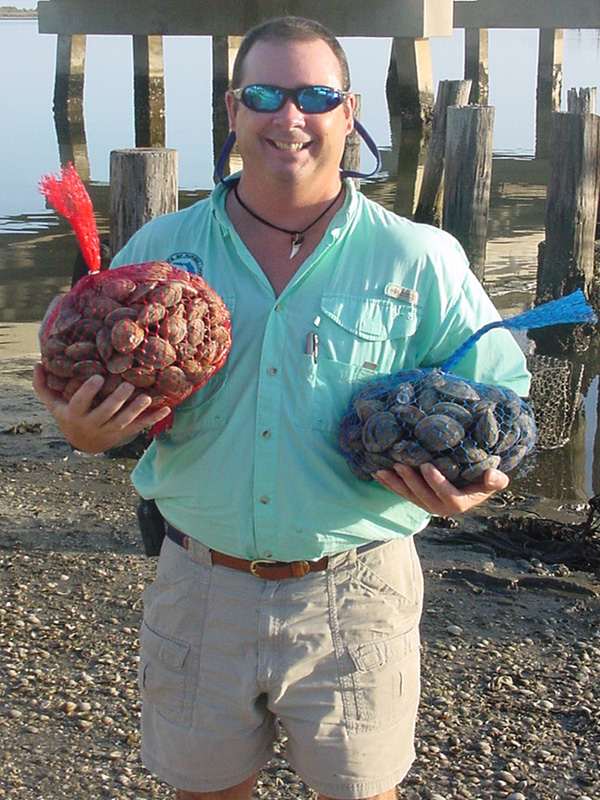
Humans are bipedal (two-legged) apes belonging to the great ape family. Humans have a highly developed brain capable of abstract reasoning, language, and introspection. This, combined with an erect body carriage that frees their upper limbs for manipulating objects, allows them to make greater use of tools than any other species. Like most primates, humans are by nature social. However, humans are particularly adept at utilizing systems of communication for self-expression and the exchange of ideas. Humans inhabit every continent with a total population of over 6.5 billion people as of 2006.
What Are The Effects On Clams?
First and foremost, humans are consumers of clams, and purchase clams grown by farmers for consumption. Humans live in coastal areas, often in sight of clam aquaculture leases. Their activities on land, such as waste disposal, placement of dwellings (zoning density), and use of fertilizers and pesticides, can affect the quality of inshore waters, the management plan of the shellfish harvesting area, and the safety of shellfish for human consumption. Humans also use inshore coastal waters for boating, fishing and recreational activities, as well as other commercial activities, such as crabbing. Sometimes these activities can cause problems for clam farmers and their crops. In particular, clam bags can be cut by a motor’s propeller when a boater runs over a lease at low tide. Further, some growers use SCUBA or hookah rigs to work their crops on high tides or on deeper leases. Unaware boaters could potentially snag this equipment causing harm to the diver. Finally, one of the biggest predators of clams is human. Losses of cultured clams from theft can be significant.
What Can A Clam Farmer Do?
Education is the key. To increase consumption of clams, a clam farmer, as well as wholesalers and retailers, must provide information to the public about the nutritional value of clams and tips on how to store, handle, and prepare clams. Marketing brochures and recipes are available through the Florida Department of Agriculture and Consumer Services, Bureau of Seafood and Aquaculture Marketing. <HYPERLINK TO http://www.fl-seafood.com/recipes/clam_recipes.htm>. A clam farmer must educate their neighbors as to the economic and environmental importance of clam farming to ensure land use regulations and practices are favorable to maintaining and preserving water quality standards for shellfish harvesting. A clam farmer must also educate boaters, informing them of the location of lease areas as well as the activities conducted on their farms. Educational signs placed at marinas, boat ramps, and on aquaculture lease markers can be used to provide appropriate warnings to the public. Further, growers must display a Diver-Down flag when using SCUBA gear or hookah rigs on their leases. Although control of human predators is problematic, cultured clams are protected by state law (Chapter 812.014, Florida Statues). Stealing of clams is grand theft of the third degree and a felony of the third degree. Some clam farmers must employ security measures, such as continuous surveillance, in order to prevent significant losses due to theft. The Florida Department of Agriculture and Consumer Services provides a reward of up to $2,500 for information leading to the arrest and conviction of individuals unlawfully possessing or harvesting cultured shellfish. Violations are to be reported to 1-800-DIAL-869.